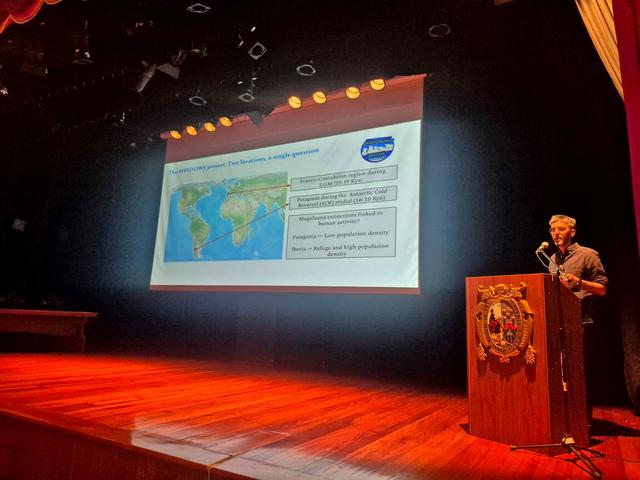
El encuentro regional Ancient Biomolecules in Latin America I reunió a investigadores y estudiantes para estudiar el pasado biológico de América Latina
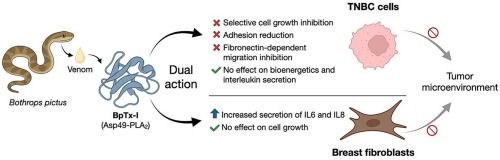
Artículo científico | An Asp49 phospholipase A2 from Bothrops pictus impairs triple-negative breast cancer cell proliferation, migration, and promotes stromal inflammatory responses with altered integrin expression.
Revista: International Journal of Biological Macromolecules.
DOI: https://doi.org/10.1016/j.ijbiomac.2026.155113
Autores: Alex Proleón, Angie Regalado, Ana Belén Tenorio, Cristopher Almarza, Gonzalo Ramirez-Negrete, Daniel Torrejón, Lucas Pino-Quezada, Rodrigo Pulgar, Jorge Martínez, Ronnie G. Gavilan, Fanny Lazo, Edith Rodriguez, Armando Yarlequé, Dan E. Vivas-Ruiz, Félix A. Urra.
Profesores de la facultad: Dra. Fanny Lazo Manrique, Mg. Edith Rodriguez Quispe, Dr. Armando Yarlequé Chocas, Dr. Dan Vivas Ruiz.
Abstract
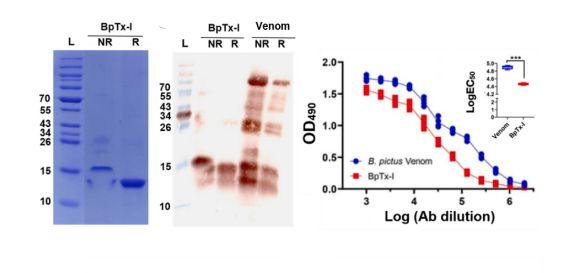
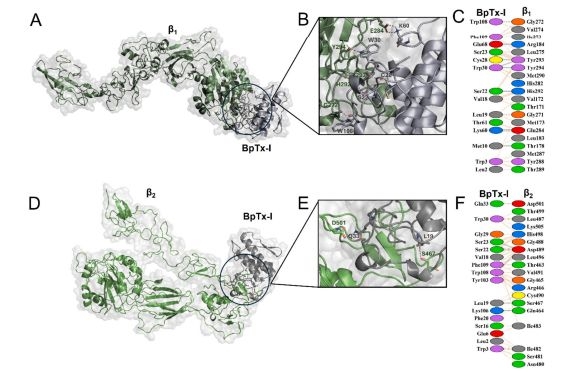
BpTx-I, a novel acidic phospholipase A2 (PLA2), was purified from Bothrops pictus venom by CM Sephadex C-25 and ENrich™ SEC 70. BpTx-I was characterized as a monomer (SDS-PAGE and DLS analysis) of 13,807.8 Da (MALDI-TOF) with predominantly α-helical secondary structure (circular dichroism). From cDNA cloning, its deduced amino acid sequence revealed high homology with other Asp49-PLA2s. It exhibited enzymatic and edema-inducing activities, lacking myotoxic effects. Using assays of impedance-based cell growth kinetics for eight cell lines (RMF621, MCF10F, MCF7, A549, HeLa, Caco-2, ZR75-1, and MDA-MB-231), BpTx-I inhibited the proliferation of cancer cell lines compared to non-cancer cells. Functionally, it arrested cell cycle in the S phase, reduced clonogenicity, and impaired fibronectin-mediated adhesion and migration in MDA-MB-231 cells. No effects on mitochondrial ROS, ATP, Δψm, mitochondrial respiration, but an increased glycolytic capacity was observed. In silico studies suggested BpTx-I might bind to β-integrin subunits. In contrast to cancer cells, BpTx-I acted as a stromal immunomodulator in RMF621 fibroblasts, upregulating ITGAV, ITGA2, and NFKB1, which triggered the secretion of pro-inflammatory cytokines (IL-6, IL-8, and IL-1β) without altering cell proliferation. These findings highlight BpTx-I as a potential lead migrastatic compound that disrupts extracellular matrix protein-cancer cell interactions and modulates the tumor microenvironment in a mitochondrial metabolism-independent manner.