
¡No calles! El hostigamiento sexual se denuncia
Artículo científico | Experimental pathogenicity of Skrjabinisakis physeteris in Wistar rats and its occurrence in Sarda chiliensis from Peru: Implications for food safety and zoonotic risk
Revista: Food and Waterborne Parasitology
Editorial: Elsevier
Enlace: https://doi.org/10.1016/j.fawpar.2026.e00342
Autores: Araceli Rodriguez-Muñoz, Rosa Martínez-Rojas, Inés Gárate, Carmen Yamashiro, Estrellita Rojas-De-Los-Santos, Abraham Delgado-Escalante, Celso L. Cruces, Jhon D. Chero, Aarón Mondragón-Martínez, Daniel Leonardo Cala-Delgado.
Profesores: Rosa Martínez-Rojas, Inés Gárate, Carmen Yamashiro, Jhon D. Chero, Aarón Mondragón-Martínez.
Abstract
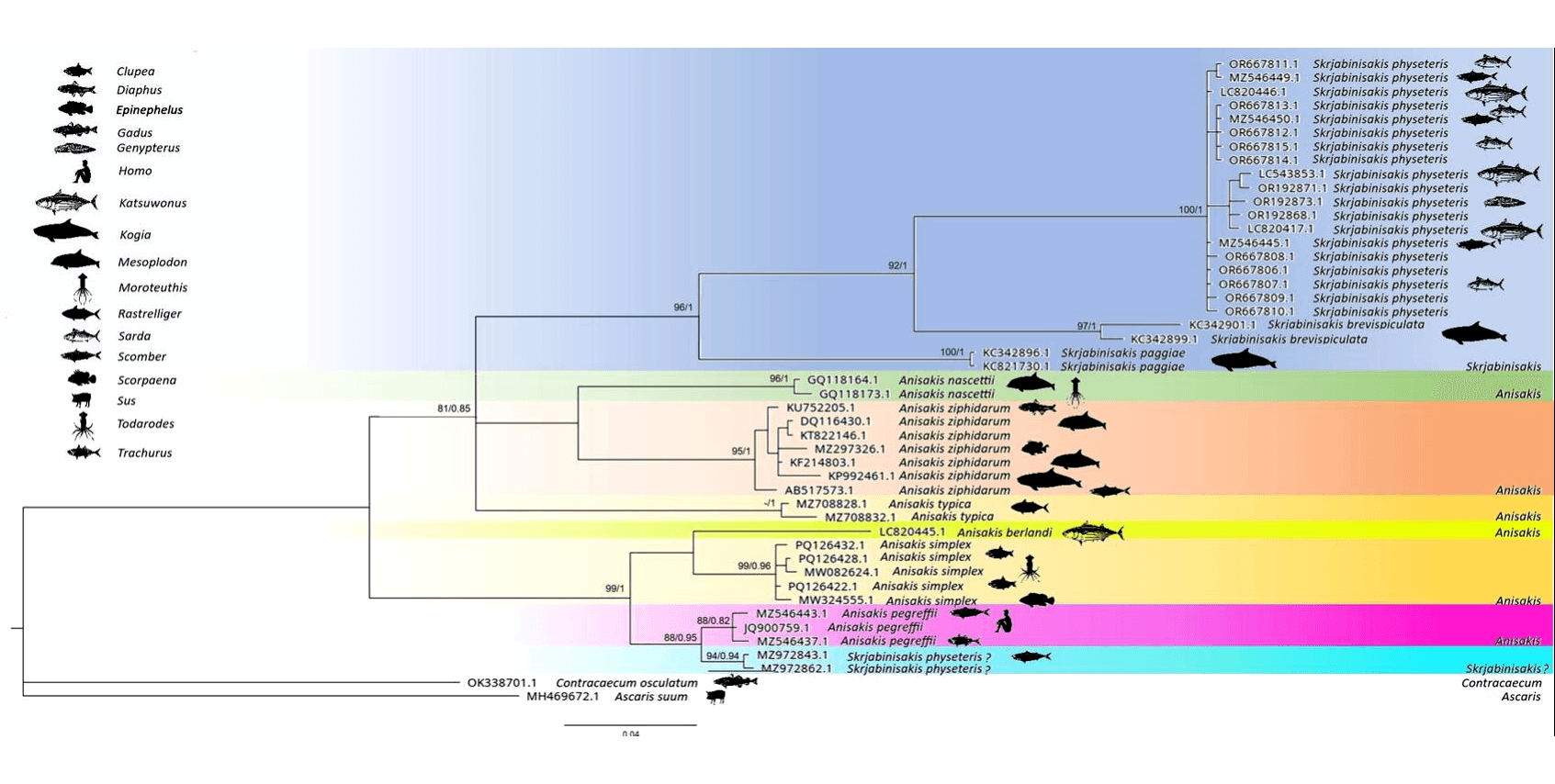
This study evaluated the experimental infectivity and pathological response of Skrjabinisakis physeteris (s.l.) larvae in Wistar rats following exposure to culinary spices commonly used in Peruvian ceviche (Citrus limon, Capsicum pubescens, Allium sativum, and Piper nigrum). Between November 2018 and April 2019, 787 specimens of Pacific bonito (Sarda chiliensis) were examined, revealing a 49.4% prevalence of anisakid larvae. Morphological analysis showed that 85.6% of recovered larvae corresponded to Anisakis Type II, which were selected for experimental infection prior to molecular confirmation. Larvae were exposed to spice treatments for 1 and 3 h to simulate traditional marination practices, and histopathological assessment was performed 48 h post-inoculation. Of the 489 larvae administered, 102 (20.9%) were associated with lesions in gastrointestinal and extraintestinal tissues. Compared with the saline control group, spice-treated larvae showed reduced recovery and pathogenicity, particularly after 3 h of exposure. Molecular characterization of a representative subset of Type II larvae based on mitochondrial cox2 sequences grouped them with reference sequences of S. physeteris available in GenBank. The observed sequence divergence was consistent with intraspecific variation within S. physeteris (s.l.). These findings indicate that the infective and pathological responses of S. physeteris (s.l.) vary following exposure to culinary spice treatments, while confirming its capacity to induce acute inflammatory and necrotic lesions in a mammalian host. This study provides molecular confirmation of S. physeteris (s.l.) in S. chiliensis from the central coast of Peru and underscores its potential zoonotic relevance in the context of raw fish consumption. These results contribute to improved risk assessment and seafood safety surveillance in the Southeast Pacific.
Últimas noticias


La Facultad de Ciencias Biológicas de la UNMSM presentó resultados de investigación que combina biodiversidad e inteligencia artificial para la búsqueda de nuevos antimicrobianos

Facultad de Ciencias Biológicas fortalece la planificación académica con reuniones de coordinación para el semestre 2026-II