
COMUNICADO Nº 15-FCB-UNMSM/2026
Artículo científico | One if by land, two if by sea: molecular phylogeny and biogeography of the Neotropical leaf-toed geckos (Phyllodactylidae: Phyllodactylus)
Revista: Zoological Journal of the Linnean Society
DOI: https://doi.org/10.1093/zoolinnean/zlag063
Autores: Kathryn A. Sullivan, Randy L. Klabacka, Alessandro Catenazzi, José Pérez Z, Pablo J. Venegas, Perry L. Wood Jr, Darren C. Browne, Claudia Koch, Jeroen P. van Leeuwen, Federico Valdez, Stuart V. Nielsen, Aaron M. Bauer, Jack W. Sites Jr, César Aguilar Puntriano, Eli Greenbaum, Tony Gamble
Profesores de la FCB: José Pérez Zúñiga y César Aguilar Puntriano.
ABSTRACT
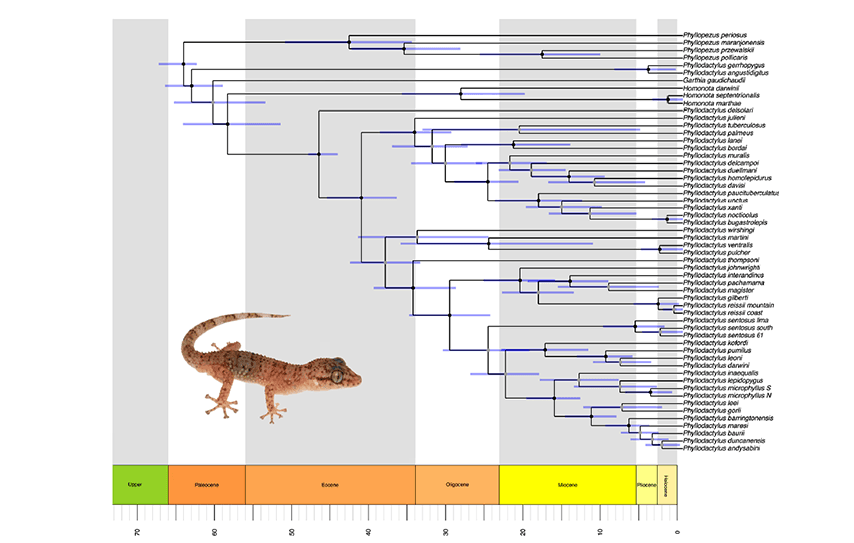
The evolutionary histories of plant and animal species are often tightly linked to geological histories. A key example is the closure of the Isthmus of Panama, which facilitated widespread biotic dispersal between North and South America after independent faunal assemblages had evolved within each region. Likewise, Andean uplift accelerated and, consequently, created many barriers that led to numerous lineage diversifications. Leaf-toed geckos (Phyllodactylidae: Phyllodactylus) represent an ideal model for exploring the impact of Isthmus of Panama closure and Andean uplift on their evolutionary history. We present the most complete time-calibrated phylogeny for this genus to date and reconstruct the biogeographical history of the group. Our phylogenetic hypotheses indicate that the North and Central American Phyllodactylus clade is older than the hypothesized time for the full Isthmus of Panama closure, and Phyllodactylus most probably dispersed over open ocean before full isthmus formation was complete. Andean uplift coincided with several divergence events, although not until the late Miocene, after many clades had already diverged. Associated instances of hidden diversity in the Andes were revealed in this reconstruction, indicating that the full extent of diversity is yet to be characterized fully. Identification of species complexes and paraphyly within Phyllodactylus has important conservation implications for the protection of these reptiles.