
Cronograma de evaluación de clase modelo y entrevista personal de los postulantes para contrato docente
Artículo científico | Beyond the full-length toxin: The metalloprotease domain of Pictolysin-III retains key functional properties and cellular activity
Revista: Biomedicine & Pharmacotherapy
DOI: https://doi.org/10.1016/j.biopha.2026.119854
Autores: Alejandro Roque, Daniel Torrejón, Alex Proleón, Victor Otarola, Juan Cabrejos, Cristopher Almarza, Ignacio Contreras Saá, Tania Broncano, Fanny Lazo, Edith Rodriguez, Armando Yarlequé, Luciana Souza Oliveira, Félix A. Urra, Dan E. Vivas-Ruiz.
Profesores de la FCB: Fanny Lazo Manrique, Edith Rodríguez Quispe, Armando Yarleque Chocas, Dan Vivas Ruiz.
Abstract:
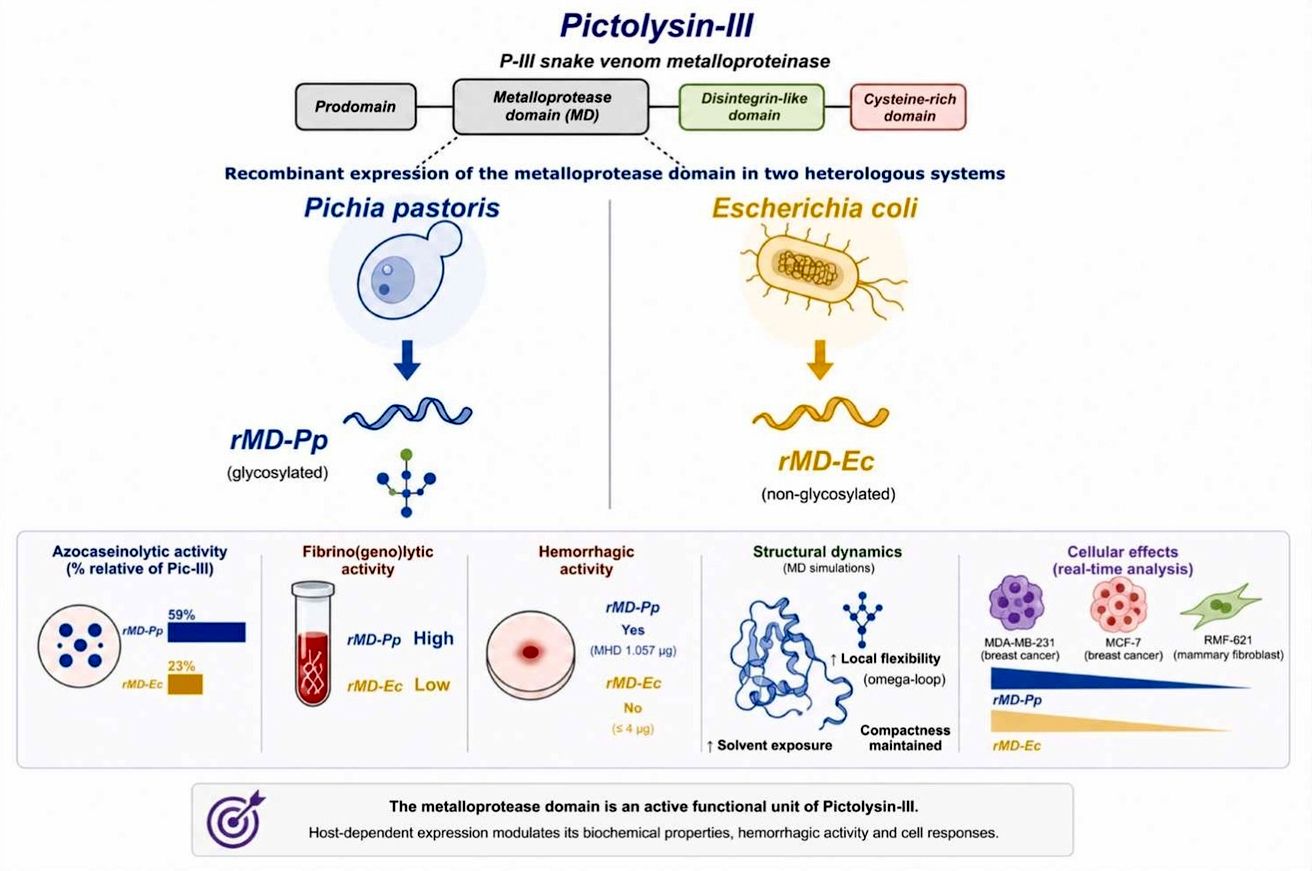
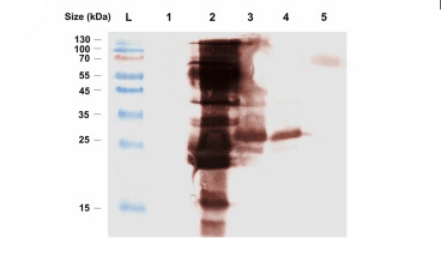
Snake venom metalloproteinases are major determinants of viperid venom pathology, but the specific contribution of their metalloprotease domain to toxin function remains insufficiently defined. Here, we produced and characterized the metalloprotease domain of Pictolysin-III, a P-III metalloproteinase from Bothrops pictus, using two heterologous expression systems: Pichia pastoris KM71H and Escherichia coli BL21 Star™ (DE3). Codon-optimized constructs containing the prodomain, an N-terminal His-tag, and a TEV cleavage site were generated, sequence-verified, expressed, purified by Ni-NTA chromatography, and activated by TEV processing. Both recombinant proteins were immunoreactive and catalytically active but showed host-dependent biochemical and biological profiles. The P. pastoris-derived protein, rMD-Pp, displayed a higher apparent molecular mass and greater final recovery than the E. coli-derived protein, rMD-Ec. Relative to native Pictolysin-III, rMD-Pp retained 59.44 ± 0.56% azocaseinolytic activity, whereas rMD-Ec retained 23.49 ± 0.79%. rMD-Pp also showed functional preservation under acidic conditions, fibrino(geno)lytic activity, and hemorrhagic activity. In contrast, rMD-Ec showed reduced proteolytic performance and no visible hemorrhagic lesion at the tested doses up to 4 µg. Exploratory molecular dynamics simulations of theoretical glycosylated and non-glycosylated models suggested comparable global compactness, with higher calculated solvent exposure and localized flexibility, particularly around the omega-loop region. Real-time cell analysis showed distinct cell-line-dependent impedance profiles in RMF-621, MCF-7, and MDA-MB-231 cells. Overall, these findings demonstrate that the metalloprotease domain constitutes an active functional unit of Pictolysin-III. However, the two recombinant preparations differed in their biochemical and biological profiles, with rMD-Pp more closely reproducing the functional properties of the native toxin than rMD-Ec.