
¡ATENCIÓN, INGRESANTES BASE 26! Evaluaciones Médicas Obligatorias
Artículo científico | Admixture and Selection Driven by El Niño–SouthernOscillation Events Shape the Genetic Structure of Octopusmimus–O. hubbsorum Complex Across the Humboldt andSouth Equatorial Current Transition Zone
Revista: Ecology and Evolution
DOI: https://doi.org/10.1002/ece3.74222
Autores: Jackeline Ruiz-Mendoza, Vanessa C. Bieker, Jaime G. Morin-Lagos, Franz Cardoso, Ximena Vélez-Zuazo, Joanna Alfaro-Shigueto, Marcial Arellano-Martínez, Raquel Siccha-Ramirez, Michael D. Martin, Jorge L. Ramirez.
Profesores de la FCB: Franz Cardoso, Raquel Siccha Ramirez, Jorge L. Ramirez.
Abstract
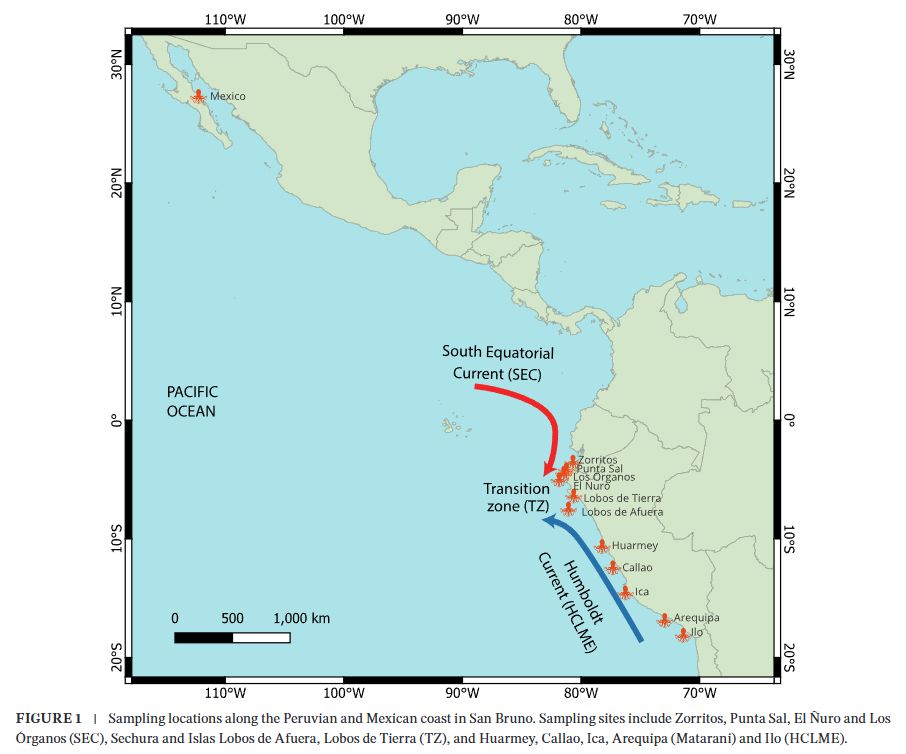
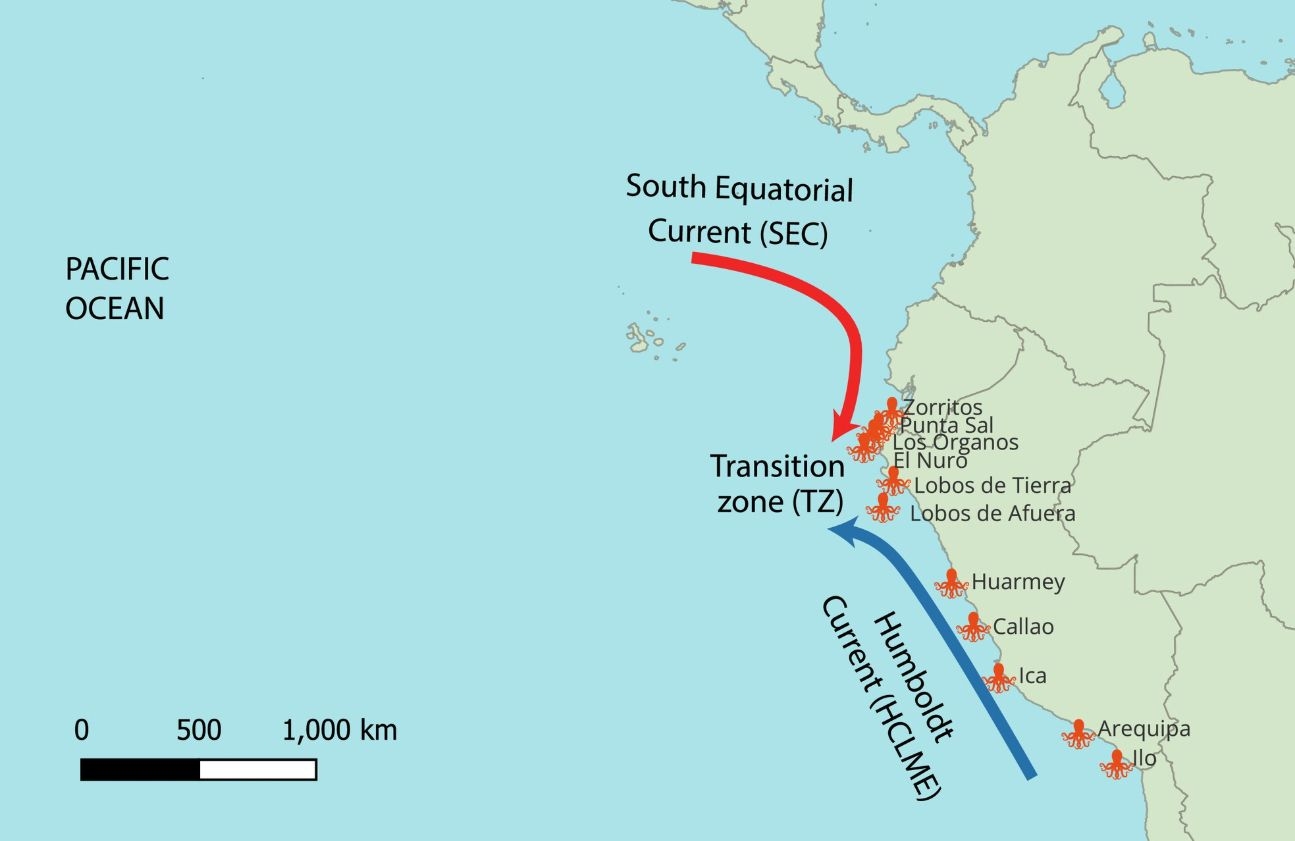
Marine transition zones, where contrasting water masses converge, can function as natural laboratories for studying admixture and early stages of speciation. The genomic structure of the eastern Pacific Octopus mimus—O. hubbsorum complex was investigated by analyzing whole-genome sequencing data from 67 individuals sampled along the west coast of the Americas, spanning Mexico and the Peruvian coast. This includes the South Equatorial Current, the transition zone, and the Humboldt Current System. The mitochondrial genomes fell into two major genetic clades that largely corresponded to the warm-water northern (O. hubbsorum) and cold-water southern (O. mimus) lineages. Analyses of the nuclear genomes revealed the same bipartite structure but also identified a broad admixture zone characterized by two different admixed clades (Admixed-Cold and Admixed-Warm). The results suggest that episodic relaxation of oceanographic barriers during El Niño–Southern Oscillation (ENSO) events promotes secondary contact and gene flow, resulting in admixed individuals recurrently during ENSO years. However, the survival of these admixed individuals depends on the adaptive genetic composition of each organism and the prevailing environmental conditions. Outlier SNP analysis supports these findings, where the Admixed-Cold cluster shares mainly the adaptive genetic component identified as outliers in O. mimus, while Admixed-Warm is linked to those in O. hubbsorum. The O. mimus–O. hubbsorum complex is currently occupying a gray zone of speciation, in which selection and climate-driven connectivity act in tandem to shape genomic divergence.
Accede a la publicación: https://doi.org/10.1002/ece3.74222